
Prince Albert is a small Karoo town in the Western Cape, tucked at the foot of the Swartberg Mountains about four hours’ drive from Cape Town, and it has quietly become one of South Africa’s most loved country escapes. People come for the Swartberg Pass and stay for the slow mornings, the Victorian streets, the farm-grown food and a welcome that locals are genuinely proud of. This guide covers how to get here, when to come, where to eat and stay, and what fills a weekend. We farm olives 4km outside the town, so consider this the view from inside the valley rather than from a travel brochure.
Where is Prince Albert?
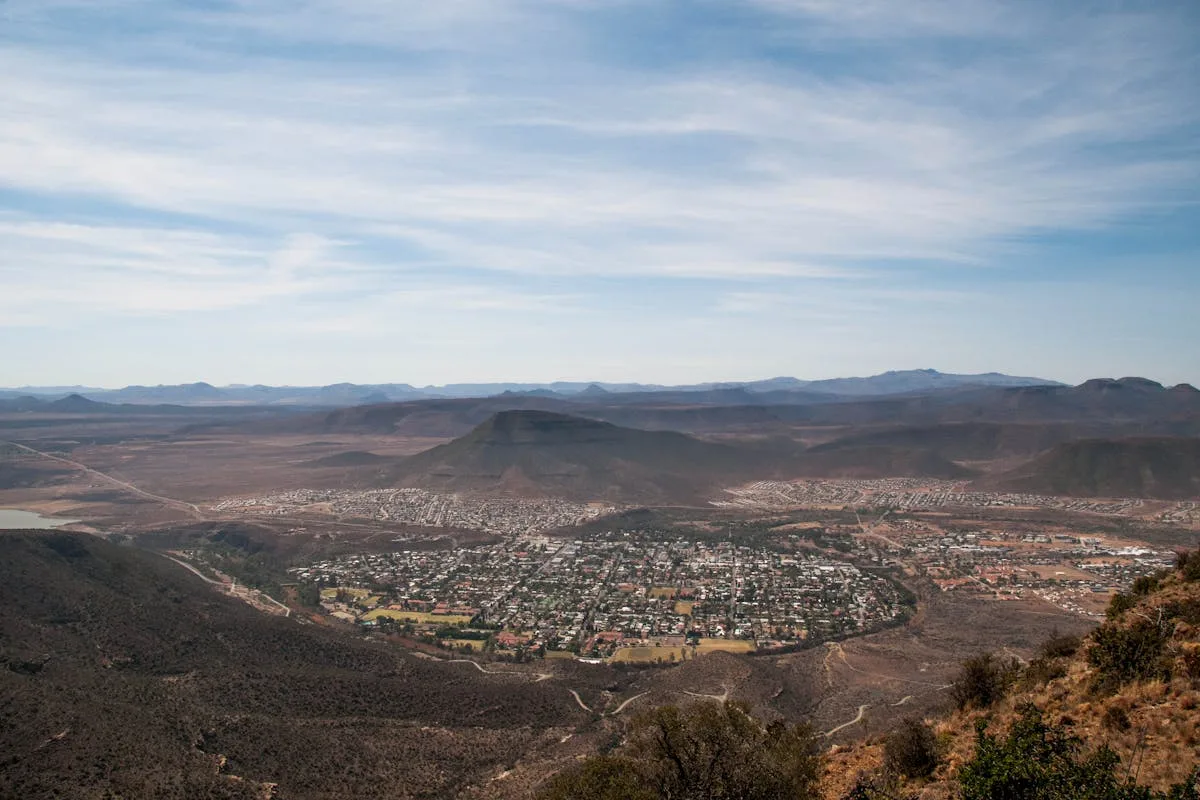
Prince Albert sits on the southern edge of the Great Karoo in the Western Cape, at the foot of the Swartberg Mountains. It falls in the Central Karoo district, and the closest larger town is Oudtshoorn, about 70km away over the mountains via the Swartberg Pass.
The setting is the whole point. To the south the Swartberg rises in folded grey rock. To the north the Karoo opens flat and wide toward the horizon. The town itself has one long main street of Cape Dutch and Victorian buildings, with water furrows still running down each side. It is the kind of place where the geography shapes the pace, and you slow down because the land urges you to.
When you first arrive, the layout of the town is easy to understand. Church Street is the spine which runs the length of the town. At one end it is anchored by the Dutch Reformed church, and most of the shops, galleries and restaurants are strung along it. Destinations in the centre are walkable within ten minutes of each other. The farms, including ours, sit just outside on the valley floor, a short drive from that main street. You can leave the car at your guesthouse for most of a weekend as you only really need it to visit the Swartberg Pass or a farm.
Around the town are working farms growing fruit, grapes and olives. That mix of mountain, desert and farmland in one small place is what gives Prince Albert its character.
For orientation, hold a map of the Western Cape. Oudtshoorn and the Garden Route sit to the south, on the far side of the Swartberg. Beaufort West and the long N1 run to the north. Prince Albert sits in the gap between them, on the quiet inland side of the mountains rather than the busy coastal side. This location is why it has remained small and has kept its character. The main routes to the coast bypass it, so the people who arrive here do so deliberately.
How far is Prince Albert from Cape Town?
Prince Albert is 392km from Cape Town, which is roughly a four hour drive. Most visitors take the N1 toward Beaufort West and turn off at Prince Albert Road, then follow the R407 for the last stretch into town.
There is a second, slower and far more scenic way in, and it is the one we recommend if you have the time. Come from the Oudtshoorn side and cross the Swartberg Pass. The pass is a gravel mountain road built in the 1880s, and the descent into Prince Albert is one of the great drives in South Africa. It takes longer but it is worth every minute. A sedan can easily navigate the pass in dry weather, though you will want to check that the pass is open before you commit, since it closes after heavy rain or snow.
Coming from Johannesburg or the Garden Route changes the approach, but the rule holds. However you arrive, the last hour is the best hour.
A few practical notes for the drive. Fuel up in Oudtshoorn or Beaufort West before the final leg, because the small towns in between cannot be relied upon for late-night petrol. If you are crossing the Swartberg Pass, do so in daylight. The gravel, the drop-offs and the lack of barriers all ask for good light, and you will want to stop at the viewpoints anyway. Allow two hours for the pass alone if you are taking it slowly, which you should. Once you reach the valley floor, the farm turnoffs, ours included, are signposted off the main road into town.
What is Prince Albert known for?
Prince Albert is known for the Swartberg Pass, its Victorian architecture, its delicious food and its unusually warm community of artists, farmers and makers. It has built a reputation as a slow food and slow living town, where what you eat was likely grown or made a few kilometres away.
The food story is real. The valley produces olives, olive oil, figs, grapes and stone fruit, and the town has leaned into that with farm stalls, a Saturday market and a clutch of good restaurants. Olive farming in particular suits the Karoo. The hot dry days and cold nights stress the trees in ways that concentrate flavour, which is partly why Prince Albert’s olive oil has a name well beyond the town.
It is worth mentioning, because it is something most visitors do not realise until they taste it. Olives store their character in polyphenols, the natural compounds that give fresh extra virgin olive oil its green, peppery catch at the back of the throat. Trees under mild stress, the kind the Karoo delivers with its heat and its cold nights, tend to make more of them. Add a short distance from tree to press, and you get oil that tastes alive rather than flat. This is the difference a working olive valley makes, and it is the difference you will taste at a farm here, versus an olive oil that has travelled the world to reach your supermarket shelf. The Karoo did not set out to be olive country. The climate is simply well suited to it.
It is also a stargazing town. The Karoo air is dry and the night skies are some of the darkest you will find within a day’s drive of Cape Town. The town runs astronomy evenings, and on a clear night you can see the Milky Way with a naked eye from your guesthouse stoep.
Then there is the architecture, which is a draw in its own right. Prince Albert has one of the best preserved collections of Cape Dutch, Karoo and Victorian buildings in the country, many of them national monuments. The flat-roofed Karoo cottages, the gabled homesteads and the wide stoeps all sit along streets still cooled by running furrow water. Walking Prince Albert feels less like visiting a museum and more like a town that simply never tore down its good buildings.
And it is a maker’s town. Artists, potters, weavers and writers have settled here over the years, drawn by the light and the quiet, and their studios and small galleries are part of what you come to see. Add the figs and the famous Karoo lamb to the olives and the wine, and you have a place that punches well above its size for food and craft alike.
What is the history of Prince Albert?
Prince Albert was founded in 1762 on a farm called Queekvalleij. The town was named Prince Albert in 1845 in honour of Queen Victoria’s consort, Prince Albert of Saxe-Coburg. The name was bestowed when the settlement gained municipal status, a detail the Prince Albert Tourism Association keeps on record.
The early settlement grew around water. The Dorps River and a network of furrows made farming possible in an otherwise dry landscape, and those same furrows still run down the main street today. By the late nineteenth century the town was an established Karoo farming centre, and the building of the Swartberg Pass in the 1880s connected it properly to Oudtshoorn and the south.
Farming shaped everything that followed. Wheat, fruit and later, olives, gave the town its livelihood, and the seasonal rhythm of planting and harvest still sets the pace today. The arrival of the railway and, later, the road over the Swartberg pulled Prince Albert into the wider Cape economy without ever turning it into a big town. It grew slowly, kept its scale, and that turned out to be its luck.
What makes the history so visible is how little has been knocked down. Walk Church Street and you are walking past homes and shopfronts that have stood for a century or more, many of them now restored. The Fransie Pienaar Museum on the Main street keeps the local records, fossils and farming tools, the odd moonshine still included. For a deeper account, South African History Online holds a full town profile. The short version is that Prince Albert is a town that grew up around water and farming in a dry land, and never lost sight of either. That heritage is not a marketing line here. It is still how the valley makes its living, ours included.
What is the best time to visit Prince Albert?
The best times to visit Prince Albert are autumn and spring, when Karoo days are warm and clear and the nights are cool rather than cold. March to May and September to November give you the most comfortable weather for walking the town, driving the pass and sitting outside for lunch.
Summer, from December to February, is hot. Karoo summer days regularly push past 35°C, so plan activities for the morning and evening and keep the middle of the day for a shaded lunch or a museum. Winter, from June to August, is cold and clear, with frosty mornings and the occasional dusting of snow on the Swartberg. Many people love it. The light is sharp and the town is quiet.
There is one more season also worth knowing about, and it is the one travel guides miss. The olive harvest runs roughly from April into May, and it is the most alive the farms get all year. If you visit then, a working olive farm is pressing fresh oil, and an olive tasting tastes of something that came straight from the tree that month. We think that makes autumn the quietly perfect time to come. If you want to plan a visit around the harvest, you can book a farm experience and see a press running.
Where to eat in Prince Albert
Prince Albert punches well above its weight, with farm kitchens, a famous Karoo lamb tradition, and cafés that rely on local produce. For a town of a few thousand people, the choice is genuinely good, and most of it sits within a short walk of the main street.
The Karoo is lamb country, and you will find it slow cooked and done properly here. Beyond that, the town’s food character is built on what the valley grows, which is where the farm kitchens come in. Our own restaurant, Café O, sits on Swartrivier Farm and plans its menu around our olives and olive oil. It is a scenic and relaxing lunch spot, with the orchard and mountains in view, rather than a fine dining room, and that is the point. For the full picture of our dining scene, our guide to Café O covers what we do and when we are open.
There is a rhythm to eating here worth knowing. Saturday mornings belong to the market, where the farm stalls and home bakers set up and you can graze your way through breakfast. Lunches are long and best eaten outside. Dinners are early by city standards, because the town winds down with the light. Coffee culture is strong for a small place, and a mid-morning flat white on the main street is a fine way to plan the rest of the day.
A practical tip. Many Prince Albert kitchens are small and seasonal, and tend to fill up on weekends. Book ahead, especially over school holidays and long weekends, and check opening hours before you head out, because a Karoo town keeps Karoo hours. If a place looks shut on a Monday or Tuesday, that is normal rather than a bad sign. Phone ahead so that you don’t get caught out.
Where to stay in Prince Albert
Prince Albert has a wide range of guesthouses, self catering cottages and country lodges, most of them in restored historic homes on or near the main street. You will not be short of options. You are choosing between character options, and almost all of them will put you within walking distance of the shops, museums and restaurants.
The town leans toward the small and the personal rather than big hotels. Restored Victorian guesthouses, garden cottages and farm stays are the norm, and many hosts have lived in the valley for years and will happily point you to their favourite walk or viewpoint. Self catering cottages suit families and longer stays, while the guesthouses are easier for a single weekend.
A few things help you choose. If you want to walk everywhere, stay on or just off the main street, where most of the restored guesthouses are. If you are travelling with family or planning a longer stay, a self catering cottage gives you a kitchen and more space, and there are good ones a short walk from the centre. If you want quiet and a view, the country stays and farm-edge cottages on the fringes of town trade walking distance for stars and silence. The town’s accommodation also tends to come with local knowledge baked in, since most hosts live here permanently.
We do not offer accommodation ourselves, so this is genuinely a case of pick what fits your trip. Book early for autumn and for any long weekend, since the better-known places go first. Wherever you land, you will be a short stroll from a morning coffee and a few minutes’ drive from the farms.
What is there to do in Prince Albert?
The headline activity is the Swartberg Pass, but a Prince Albert weekend is really about combining the big drive with the smaller pleasures: the market, the farm tastings, the walks and the immense night sky. There is more than enough to fill two or three days without rushing.
Start with the pass. Drive it slowly, stop at the viewpoints, and give yourself a couple of hours. Back in town, the Saturday market and the main street galleries and farm stalls make for an easy morning. Apart from the pass, olive and olive oil tasting is one of the signature experiences here, and an olive farm experience walks you through how cold pressed extra virgin olive oil is actually made, from tree to bottle. For deeper itineraries, our weekend guide and our things-to-do guide both go further than this page can.
If you like the outdoors, there is more. The Swartberg Nature Reserve has hiking trails and caves with San rock art, and the back road to Die Hel, the remote Gamkaskloof valley, is a serious but unforgettable drive for the well prepared. Closer to town, easy walks along the furrows and up the lower slopes give you the Karoo light without any commitment. The Fransie Pienaar Museum is worth an hour for the local history, and the stargazing evenings are the best possible way to end a clear night.
A simple way to plan it: pass and viewpoints on day one, town and farms on day two, and a slow walk plus a long lunch to finish. That leaves room for the thing Prince Albert does best, which is to let you do less than you planned and enjoy it more.
Planning a Karoo escape?
See how a working olive farm fits into your Prince Albert weekend, from tastings to lunch with a mountain view. Plan my farm visit
Is Prince Albert worth visiting?
Prince Albert is worth visiting for anyone who wants the real Karoo without a long, hard journey to find it. It gives you a dramatic mountain pass, a beautifully preserved town, dark night skies and farm-fresh food in one compact, friendly package, four hours from Cape Town.
It rewards a certain kind of traveller. If you want nightlife and shopping malls, this is not your town. If you want to slow down, eat well, drive a great road and talk to people who actually make things, it is hard to beat. The town has held onto something that many places have lost, and you feel it within an hour of arriving.
This is also why we farm here. The same things that make Prince Albert so special for a weekend, the climate, the soil and the pace, are the things that make the olives so good. Come for the town and let the farm be part of the trip.
Make the farm part of your trip
Olive tastings, a press in season and lunch at Café O, 4km from the main street. Plan my Prince Albert visit
Looking to take some Karoo olive oil home? Find a stockist near you.
Frequently asked questions about Prince Albert, South Africa
Where is Prince Albert, South Africa?
Prince Albert is a small town in the Western Cape, on the southern edge of the Great Karoo at the foot of the Swartberg Mountains. It falls in the Central Karoo district, about 70km from Oudtshoorn over the Swartberg Pass.
How far is Prince Albert from Cape Town?
Prince Albert is 392km from Cape Town, about a four hour drive. The fastest route runs via the N1 and the Prince Albert Road turnoff, while the scenic route comes over the Swartberg Pass from the Oudtshoorn side.
What is Prince Albert known for?
Prince Albert is known for the Swartberg Pass, its preserved Victorian architecture, its artisan and slow food scene, and its dark Karoo night skies. The valley’s olives, olive oil, figs and stone fruit are central to the town’s reputation.
What is the best time to visit Prince Albert?
Autumn and spring are the best times to visit Prince Albert, with warm clear days and cool nights from March to May and September to November. The olive harvest in April and May is a particularly rewarding time for farm visits.
Is Prince Albert worth visiting?
Yes. Prince Albert offers a dramatic mountain pass, a historic town, farm-fresh food and some of the darkest skies near Cape Town, all within a four hour drive. It suits travellers who want to slow down rather than chase nightlife.