
A growing body of evidence suggests that South African extra virgin olive oil is not only fresher and more traceable than many imported alternatives — it may also be more likely to be genuine. With 26 percent of imported olive oils in South Africa failing quality tests for extra virgin classification, local producers are making a compelling case for buying homegrown.
The Import Problem Few Consumers Know About
South Africa consumes approximately 7 to 8 million litres of olive oil every year. Of that, roughly 80 percent is imported — primarily from Spain, Italy and Greece. The domestic industry produces only about 1.6 million litres annually, leaving a significant gap that foreign oils fill.
But a testing programme conducted by SA Olive in conjunction with the International Olive Council revealed a troubling finding: 26 percent of imported oils labelled as “extra virgin” failed to meet the chemical and sensory standards required for that classification. By contrast, not a single locally produced oil failed the same tests.
The problem is not unique to South Africa. A widely cited study by the University of California, Davis found that 69 percent of imported extra virgin olive oil samples sold in American supermarkets did not meet international standards. In 2001, the South African Police Service investigated a multi-million Rand fraud scheme in which confiscated oils turned out to be sunflower oil — one sample even contained a petrochemical solvent used to clean motor engines.
Why South African Olive Oil Scores Higher on Quality
Ninety-five percent of all olive oil produced in South Africa qualifies as extra virgin — the highest grade available. This is not a marketing claim. It reflects the fact that local producers, most of whom are small-scale farmers managing fewer than five hectares, harvest and press their olives within hours rather than days.
The freshness advantage matters more than many consumers realise. Imported oils travel by sea for weeks before reaching South African shelves. During that time, exposure to heat, light and oxygen degrades the polyphenols and antioxidants that make extra virgin olive oil valuable — both for flavour and for health. A bottle of locally pressed oil, by contrast, moves from grove to shelf within the same country, often within the same province.
The Western Cape accounts for 93 percent of South Africa’s olive oil production. Farms in the Karoo, Swartland, Breede River Valley and Cape Winelands benefit from a Mediterranean-type climate that suits olive cultivation remarkably well.
A Small Industry Punching Above Its Weight
South Africa represents less than one percent of global olive oil production. Yet its producers consistently win at the highest international competitions. In 2025, South African estates entered 17 international competitions and took home gold medals from events including the New York International Olive Oil Competition, the Amsterdam IOOC and the EVO International Olive Oil Contest in Italy.
De Rustica, a Klein Karoo estate, scored 96 points to rank second in the world and first in South Africa. Rio Largo achieved 99 out of 100 in the Flos Olei Guide 2026. The XXV range from Willow Creek won Best International Entry for the Southern Hemisphere at the EVO IOOC.
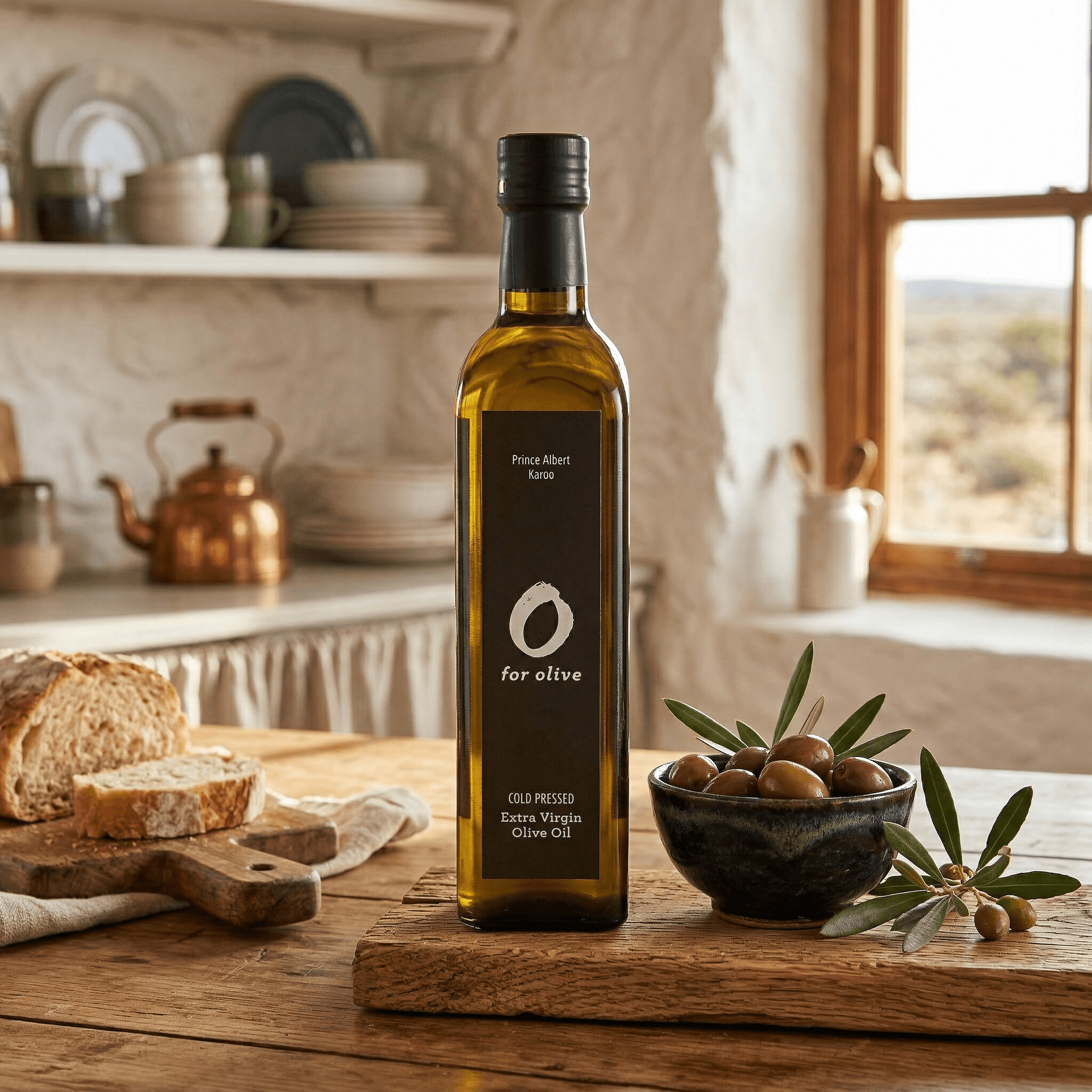
These results demonstrate that South African terroir — including the dry, mineral-rich soils of the Karoo — produces oils that rival those from centuries-old Mediterranean groves. At O for Olive, cold pressed olive oil from Swartrivier Farm in Prince Albert carries the same Karoo character: robust, peppery and rich in polyphenols.
How to Know What You Are Buying
The simplest way to verify quality is to look for the SA Olive Commitment to Compliance (CTC) seal. This voluntary certification guarantees that the oil is 100 percent South African in origin, displays a harvest year and has been tested by an independent organoleptic tasting panel.
Other indicators of a genuine extra virgin olive oil include a harvest date on the label rather than just a best-before date, dark glass or tin packaging that protects the oil from light, and a flavour profile that includes a peppery finish — an indication of high polyphenol content. If the oil tastes flat or greasy, it is unlikely to be true extra virgin.
Consumers should also be cautious of prices that seem too low. European olive oil producers receive substantial government subsidies, which allows imported oils to undercut local producers on price. This does not reflect a quality advantage — it reflects a subsidy one.
The Health Case for Extra Virgin
The landmark PREDIMED study, published in the New England Journal of Medicine and involving 7,447 participants over nearly five years, found that a Mediterranean diet supplemented with extra virgin olive oil reduced the risk of major cardiovascular events by 30 percent. Stroke risk, in particular, was significantly lower in the olive oil group.
These benefits are linked to the polyphenols and oleocanthal found in fresh, high-quality extra virgin olive oil — the same compounds that degrade during long-distance shipping and extended storage. Choosing a locally produced oil, pressed close to home and consumed within months of harvest, maximises the health value of every tablespoon.
Why Buying Local Matters
South Africa’s olive industry is the fastest-growing agricultural sub-sector in the country, expanding at approximately 20 percent per annum. Hectares under cultivation have more than doubled since 2008, from 1,357 to nearly 2,900. Yet per capita consumption remains just 0.08 litres per year — a fraction of the 12 to 18 litres consumed annually in Mediterranean countries.
Every bottle of South African extra virgin olive oil purchased supports a local farming community. At O for Olive, that means Swartrivier Farm in Prince Albert — a Karoo olive farm with over 3,000 mature trees, its own processing plant and a commitment to producing cold pressed oil of the highest standard.
The data is clear. The awards confirm it. And the taste speaks for itself.
Find a stockist near you or visit the farm to taste the difference for yourself.

